|
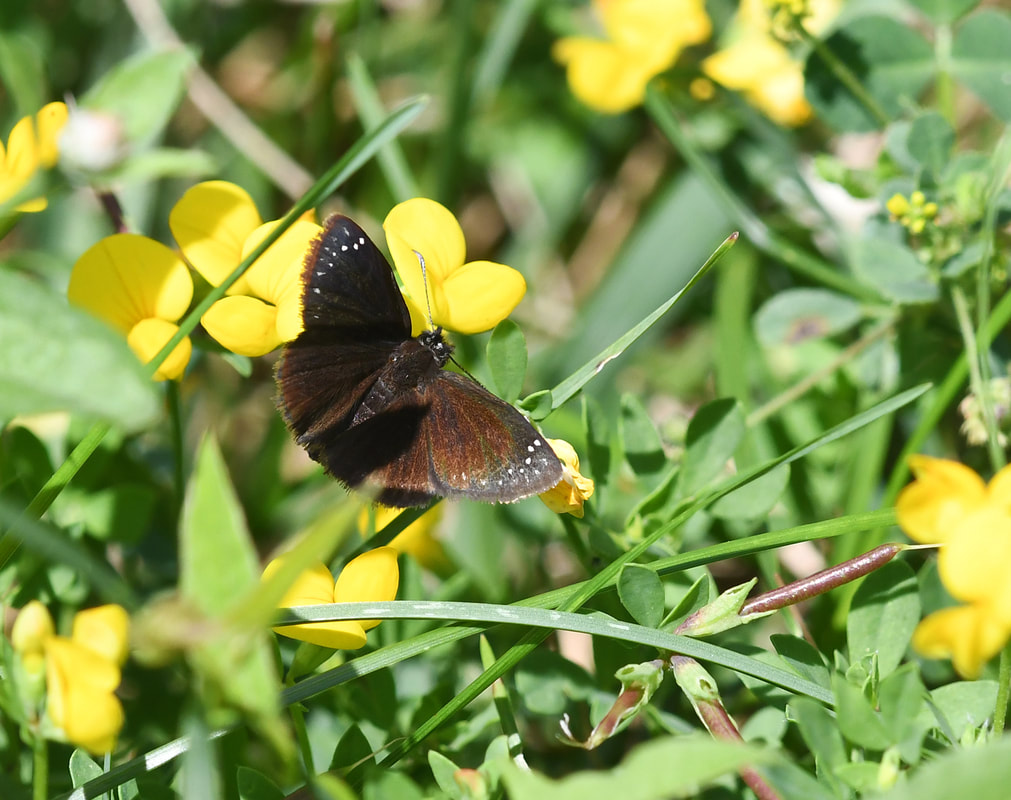
My interests shifted to insects for much of the summer, as documented in my previous post. That blog was growing a little long and so I had left out some of the other insect highlights from the summer that were not moths. I’ve included a few of them below. Reid Conservation Area in Lambton County is home to Canada’s only known population of Southern Hairstreaks, first discovered by Blake Mann in 2008. My visit was ill-timed by a few days and the individuals I lucked into were rather worn, but it was a treat to see this rare species. Baz Conlin and I experienced an epic weekend in Essex County in late August, highlighted by many rare moths. During our first afternoon at the Ojibway Prairie we found this pink Oblong-winged Katydid. While green is the typical colouration it is also possible to find pink, orange, tan, or yellow individuals. Research suggests that the allele which causes pink colouration is dominant to the allele for green colouration, but since the pink individuals are susceptible to predation, this phenotype is seen less frequently in the wild. A quick check of the roosting gulls at Port Dalhousie on August 11 produced a surprise Brant, blending in with the gulls at the end of the pier. This bird remained in the area for the rest of the summer and autumn and was subsequently observed by many others. Check out this amazing photo… By August the nights grew a little cooler, spurring autumn bird migration in earnest. I dusted off the binoculars and headed out on a few occasions. In late August and early September I twitched a trio of rare birds that others had first observed. These included a Laughing Gull that Wally Parker discovered in Fort Erie, a Western Sandpiper that James Lees found in Flamborough, and a long-staying Purple Gallinule that Steve Charbonneau noted at the Blenheim lagoons. All three of these birds were juveniles. Individuals from this age class seem to get lost more frequently and turn up out of range. Laura and I regularly visited several natural areas close to our house in St. Catharines. One excursion to Short Hills produced this incredible wasp. The ovipositor alone was close to 15 cm in length! Like many narrow-waisted wasps, this species is parasitic and uses another insect as its host. In this case, it utilizes woodwasp larvae. In September I birded many of my local hotspots in Niagara Region. I enjoyed several excellent days of lake-watching, such as September 2 when I found my first Long-tailed Jaeger and Red-necked Phalarope for Niagara, and September 11 in which I noted Long-tailed and Pomarine Jaegers at Port Weller. A strong southwest gale on September 7 meant that Fort Erie was the place to be. This was a good choice as three Red-necked Phalaropes and nine Black Terns were feeding low over the river by the Peace Bridge with the numerous Bonaparte's Gulls. It was wonderful sharing these birds with a number of local Niagara birders. Jones Beach in St. Catharines was one of my frequent haunts in the early autumn. Shorebirds can occasionally show up here and September 2020 was an excellent month. Below are some of my favourite bird photos from Jones Beach this autumn. A local photographer discovered a Hudsonian Godwit on Jones Beach which was relocated by Roy Sorgenfrei the following day at Port Weller. This was an exciting twitch that I shared with a few other Niagara birders. It is always fun when I can add a bird to my Niagara list from my local patch of Port Weller. In late September I embarked on a three-day road trip. The main goal of this trip was to search for a Northern Wheatear that had been found by Roxane Filion in South Porcupine. The wheatear cooperated, but the rest of the trip was just as enjoyable. There are few places in Canada I would rather be than northern Ontario in the autumn. Unseasonably warm temperatures allowed me to sneak in some late-season mothing near Tilden Lake. And so ends Part 5. The final instalment will cover the last three months of the year.
1 Comment
|
Archives
February 2026
|
RSS Feed